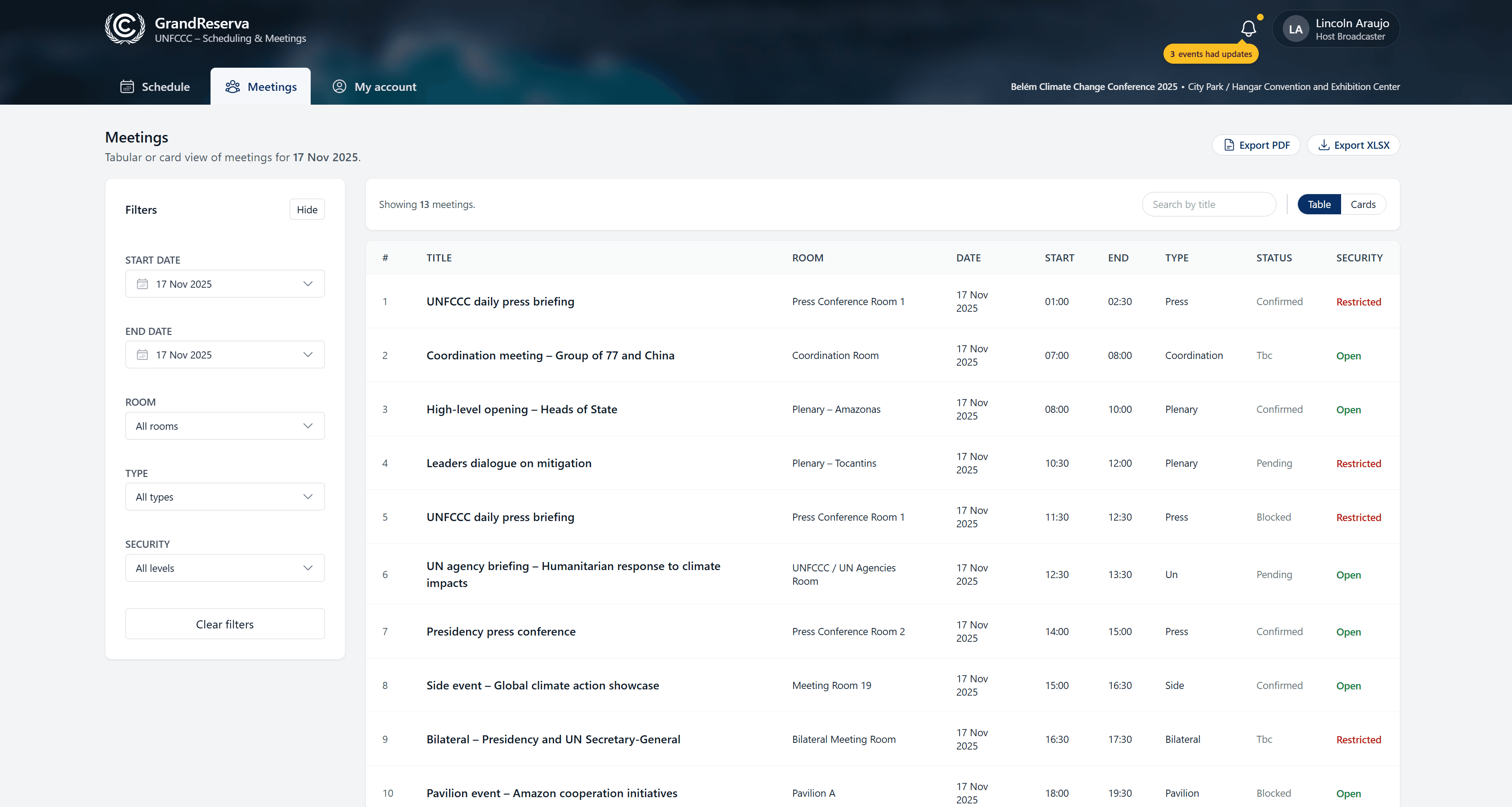
Main dashboard
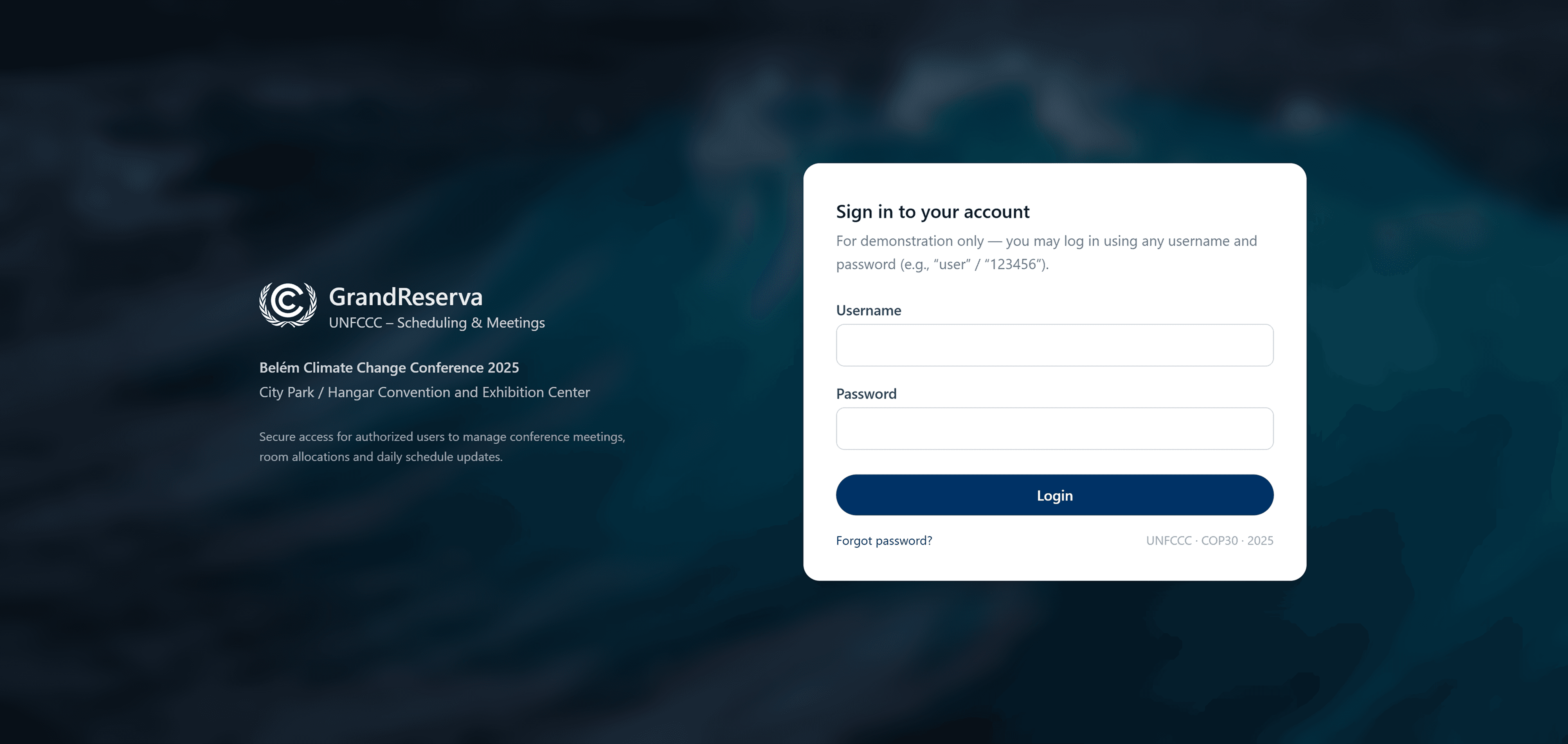
The redesign clarified the overall structure of the system and made the interface feel more official, intentional, and aligned with the UNFCCC brand.
UX / UI / Frontend Prototype / Self-initiated Project
Reimagining an outdated event scheduling system into a clearer, more credible, and mobile-friendly experience for high-stakes operational use.
Context
Grand Reserva was the official scheduling system used during COP30 operations. I came into direct contact with it while working on-site in Belém and needing to check, update, and distribute daily schedules quickly to a large internal team.
The system was difficult to understand, visually outdated, and especially painful to use on mobile. Tables behaved like desktop spreadsheets compressed into a phone screen, forcing users to zoom, scroll horizontally, and repeatedly recover context.
Because schedule changes happened daily, this was not a minor inconvenience. It was a recurring operational problem. The redesign began as an attempt to show that the system could become clearer, more credible, and much easier to use without necessarily being rebuilt from scratch.
My Role
This project was entirely self-initiated. I designed and prototyped it on my own while still working on-site at COP30, using short windows of time and a small number of free hours to turn a real pain point into a concrete proposal.
Because of the time constraints, I focused on the most visible and recurring problems: mobile usability, responsiveness, readability, filter clarity, stronger interface hierarchy, and a more credible visual language aligned with the UNFCCC context.
Challenge
This was not a speculative redesign done from distance. It happened during an intense month of work, in the middle of COP30 operations, while I was still using the original system daily for time-sensitive coordination tasks.
The redesign had to be fast, practical, and credible. It needed to show that the system could become more usable and more aligned with the importance of the institution behind it, without pretending that implementation would be easy or unconstrained.
That meant balancing ambition with realism: proposing a better experience while still respecting the possibility that any real evolution of the system would depend on budget, team capacity, and technical limitations.
Designing quickly under extreme time pressure during COP30.
Improving a system that was widely disliked but still operationally essential.
Making the experience work credibly on mobile, where the original system failed badly.
Suggesting meaningful improvement without assuming a full rebuild would be possible.
Building a polished enough MVP to be taken seriously in conversation with the UNFCCC team.
Key experience decisions
The redesign clarified the overall structure of the system and made the interface feel more official, intentional, and aligned with the UNFCCC brand.
Core schedule information became easier to scan, with better hierarchy, less spreadsheet-like density, and a clearer sense of what matters most.
Alternative views helped users navigate event information more comfortably, depending on task and context.
A notification concept highlighted which event rows had changed, helping users identify updates more quickly instead of manually comparing versions.
One of the strongest improvements was making the experience work more credibly on small screens, including responsive treatment for tables and an alternative card-based view.
Reflection
Grand Reserva was not a commissioned project. It came from seeing a system in active use, feeling its limitations in a real operational context, and believing that it could be much better.
What made the project especially meaningful to me was the context around it: the possibility that improving a system like this could help people work faster, more clearly, and with more confidence during an internationally important event.
Even if the proposal never gets implemented, I value the fact that it became something tangible, presentable, and real enough to open a serious conversation. For me, that already meant planting a seed.
Portfolio
Explore the homepage, revisit the selected projects, or continue through the About page.