Global player
The player becomes active when a live radio or on-demand audio action is triggered and stays fixed at the bottom of the interface, allowing users to keep listening while navigating.
Before
After
Frontend Engineering / UX / Interface Architecture
Reimagining the digital experience of EBC’s radio platforms through content-rich architecture, accessibility, and interface clarity.
Context
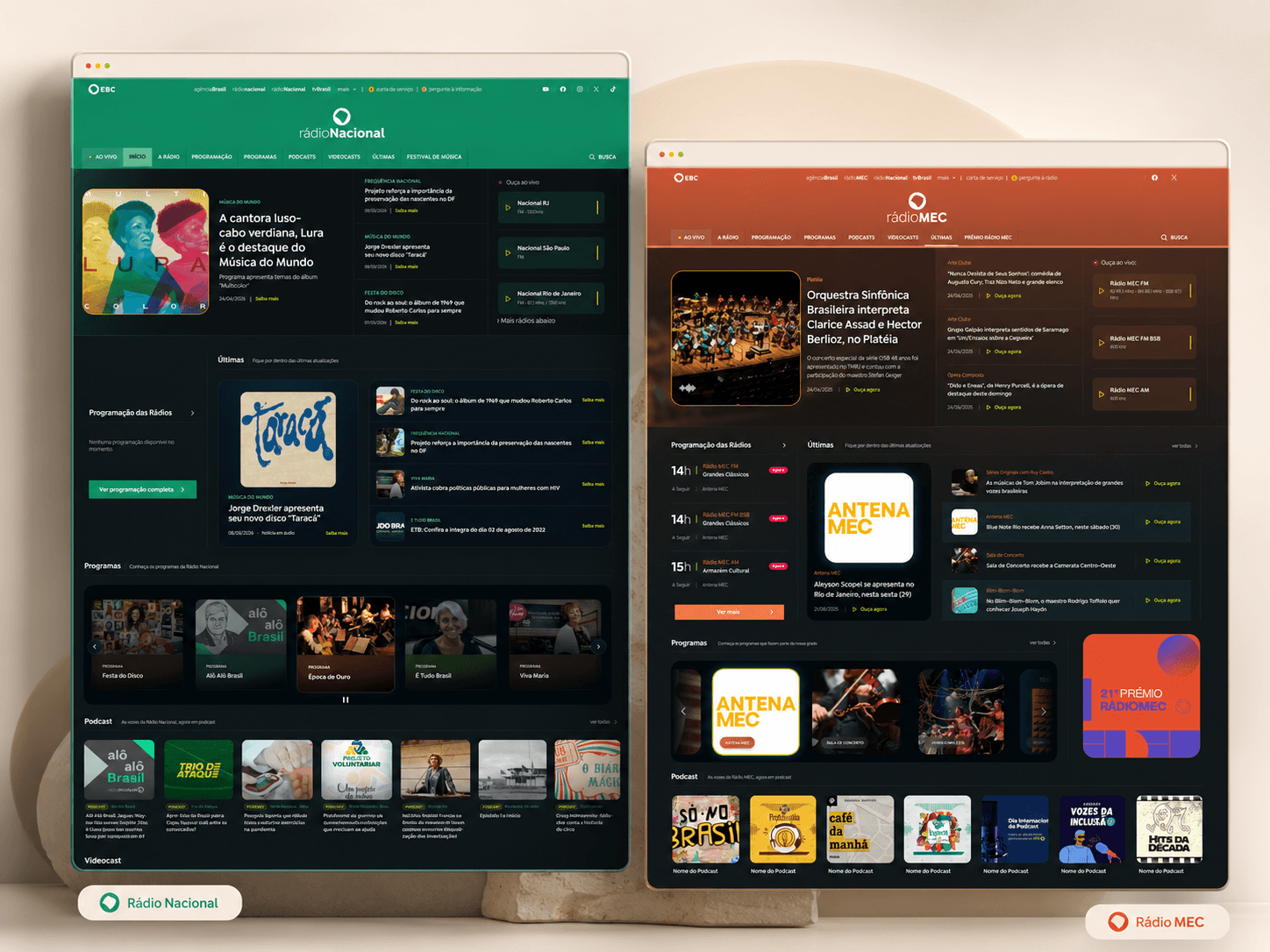
Radio MEC and Radio Nacional were redesigned as two new digital platforms for EBC’s radio brands. Previously, both brands shared the same website, which blurred their identities and forced them into an outdated, restrictive experience.
The legacy platform had been online for over a decade and no longer reflected the brands, the content model, or the expectations of a modern audio product. Live radio players were difficult to find, content discovery was limited, and the experience behaved more like an old institutional portal than a platform designed for listening.
At the same time, both brands had already gone through a visual refresh, while the website still carried the tone of an older and more traditional identity. The project needed to transform that gap into something more coherent, immersive, and clearly aligned with the idea of a digital audio platform.
Legacy portal
Shared website before redesign
Redesigned portal
New platform after launch
My Role
I was the sole person responsible for UX and frontend across the project, working alongside backend, infrastructure, technical leadership, and the internal stakeholder who owned the platform.
My role covered the product from multiple angles: identifying pain points, aligning user and editorial needs, shaping interface architecture, translating brand guidelines into digital experience, implementing the frontend, and contributing to how the platform worked behind the scenes.
Challenge
The challenge was not limited to modernizing a dated interface. The project had to turn a fragmented platform into a coherent digital audio product while also improving the editorial workflows behind it.
On the audience side, the portal needed to support a more natural streaming-oriented experience, where users could listen while navigating, discover content more clearly, and move through the platform without losing context.
On the editorial side, the product needed to become easier to manage, especially in complex areas such as programming schedules, publication states, and content organization.
Building a production-ready project while learning Plone 6 in practice.
Designing for two audiences at once: listeners and editors.
Combining live radio, podcasts, videocasts, editorial content, and discovery in one coherent product.
Making the platform feel more like an audio streaming experience than a traditional news portal.
Creating internal tools such as the editorial dashboard and the new programming workflow.
Approach
For the audience, the goal was to make the experience feel less like a traditional institutional portal and more like a platform centered on audio, continuity, and discovery. Navigation, hierarchy, and the placement of key components were all designed to support that shift.
For editors, the goal was to reduce operational friction. Instead of treating administrative work as something separate from experience, I approached it as part of the same product problem: if the people managing the platform struggled with schedules, publishing, and organization, that would directly affect the quality of the public portal.
This led me to work on both fronts at the same time: the public experience for listeners and the internal tooling that supports the platform behind the scenes.
Working principle
I do not separate interface quality from system logic. Experience, structure, content architecture, and workflow design are all part of the same product problem.
Key experience decisions
The player becomes active when a live radio or on-demand audio action is triggered and stays fixed at the bottom of the interface, allowing users to keep listening while navigating.
The schedule became clearer for listeners and dramatically easier for editors, with recurring weekday logic, special schedules, copy actions, validations, and time safeguards.
The new search is intentionally simple and focused, helping users find radio-specific content through covers, titles, dates, and direct access with much more clarity.
The homepage works as a condensed expression of the platform, combining hero, programming, latest content, programs, podcasts, and videocasts into a coherent opening experience.
The content page became more immersive and integrated with the rest of the portal, supporting playback, sharing, feedback, related content, and richer contextual information.
Reflection
For listeners, the redesign made the platform feel more fluid, more immersive, and much more clearly centered on audio. It became easier to understand what was available, what was currently playing, and how to continue exploring without losing context.
For editors, the project brought more clarity and control to daily operational tasks, especially in areas such as programming and publication management. Improving those workflows was just as important as refining the public-facing interface.
More than anything, this work reinforced something that has become central to how I operate: interface quality, content architecture, system logic, and editorial workflow are not separate layers. They shape the same product experience together.
Next project
Institutional and public communication interfaces designed with clarity, consistency, and scalable structure.